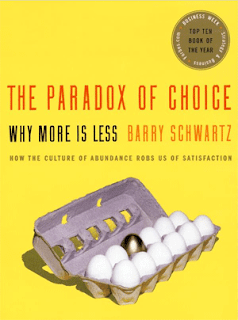
The book provides lots of stories of why more choice doesn’t bring us more freedom. From the story of picking the jeans, the author felt not satisfied after the clerk provides lots of choices of jeans, even though he was looking for a pair of normal jeans. He didn’t feel happier when he got what he want.
The simple reason is that all options you didn’t choose become loss, and people hate loss. The excitement you choose what you like was wiped away by the loss.
And that is the core idea of the book. However, the book also touched other aspects of choices, which I think is worth to know.
Be a Satisficer, not a Maximizer
The book brings the idea of “maximizer” and “satisficer”. Maximizer wants the best, and satisficer wants good enough according to its own standards. Maximizer might did better than satisficers objectively, but worse subjectively. Maximizer didn’t enjoy positive events as satisficers, and didn’t cope as well with negative events (by their own admission). People with high maximization scores experienced less satisfaction with life, were less happy, were less optimistic, were more depressed, and were high on regret.
I believe that being a maximizer does play a causal role in people’s unhappiness, and I believe that learning how to satisfice is an important step not only in coping with a world of choice but in simply enjoying life. You can generate if only’s indefinitely, and each one you generate will diminish the satisfaction you get from the choice you actually made.
When maximizers make decisions, they also think too much about anticipated regret – “what if it doesn’t work”. Anticipated regret will make decisions harder to make, and postdecision regret will make them harder to enjoy. To satisfice is actually the ultimate maximizing strategy.
Why would anyone maximize? First, many maximizers may not be aware of the tendency in themselves. Second is our concern with status. If you’re in competition with scarce goods, there will never be “good enough”. So does choice creates maximizers? Choices enable people engage in the world, but when we have more choices we have higher expectations of them, and we become less satisfice from our choices. Hence, the choice of when to be a chooser may be the most important choice we have to make.
How are we going to do that? We can use second-order decisions. One kind of second-order decision is the decision to follow a rule. This reduces the stress of making trade-offs everywhere, which is the reason why people unhappy and indecisive.
Difficult trade-offs make it difficult to justify decisions, so decisions are deferred; easy trade-offs make it easy to justify decisions. And single options lie somewhere in the middle. Conflict induces people to avoid decisions even when the stakes are trivial.* Based on these studies, and others like them, researchers concluded that when people are presented with options involving trade-offs that create conflict, all choices begin to look unappealing.
Maximizers ruminate and compare, Satisficers don’t
Unhappy has strong connection with rumination. The author thinks that the tendency to ruminate traps unhappy people in a downward psychological spiral that is fed by social comparison, and it happens often on maximizers.
Maximizers were much more affected by the presence of another person than satisficers were.
In addition, when maximizers and satisficers were asked questions about how they shop, maximizers reported being much more concerned with social comparison than satisficers did. They were more attentive than satisficers to what other people were buying, and more influenced in judgments of their own satisfaction by the apparent satisfaction of others.
The maximizer becomes a slave in her judgments to the experiences of other people. Satisficers don’t have this problem. They can rely on their own internal assessments to develop those standards.
While, in theory, “the best” is an ideal that exists independent of what other people have, in practice, determining the best is so difficult that people fall back on comparisons with others. But critically, it will not, or need not, be relative to either the standards or the achievements of others.
“Good enough” is not an objective standard that exists out there for all to see.
What we can do is controlling our expectations
Expectation also plays a huge role in making choices. An experience will feel positive if it is higher than expectation, and vice versa. We probably can do more to affect the quality of our lives by controlling our expectations than we can by doing anything else. The blessing of modest expectations is that they leave room for many experiences to be a pleasant surprise, a hedonic plus. The challenge is to find a way to keep expectations modest, even as actual experiences keep getting better.
One way of achieving this goal is by keeping wonderful experiences rare. This may seem like an exercise in self-denial, but the author don’t think it is. On the contrary, it’s a way to make sure that we can continue to experience pleasure.
We are limited only by our imaginations. We have less control over social comparison. We live in a social world and we are always being hit with information about how others are doing.
This kind of information just can’t be avoided. The best we can do is keep ourselves from brooding about it.
There are also some other interesting studies:
When we speak out why we choose, the words affected our decisions because we think what we say is the reason, but the reason is not always simple.
What brings us happiness? The author thinks is close relationships and the casuality probably works both ways. Our social fabric is a series of deliberate and demanding choices, and close attachment, not acquaintanceship, is what people most want and need.
We should try to do more downward counterfactual thinking. While upward counterfactual thinking may inspire us to do better the next time, downward counterfactual thinking may induce us to be grateful for how well we did this time.
People experience and express gratitude helps us get out of our adaptation of what we have now, and people who experience gratitude are moe alert, enthusiastic, and energetic than those who do not, and they are more likely to achieve personal goals.
Lyubomirsky found that happy people were only minimally affected by whether the person working next to them was better or worse at the anagram task than they were.
When people pursue goods that are positional (we get them based on our position in the society), they can’t help being in the rat race.
The more difficult information gathering is, the more likely it is that you will rely on the decisions of others.
I think the book is a little bit less organized, the topics in previous chapters were bringed up again later, but all of them are good to know. I think the most important take away is “To satisfice is actually the ultimate maximizing strategy”, I am applying it into my life and I am excited to see how it goes.
And we are not good predictors. When we make decisions that we think it will be the best, it is not guaranteed the best. So I think the feeling of your choice is also important. When you are in good mood, “going with your gut”, you usually feel good about your choice, and it usually turns out to be good.
This is the lesson I learned the most from my personal experience, and from now on I’ll trust myself.
Or trust the universe? Next book: The Surrender Experiment